Feed Salone Gains Momentum as MAFS-LLDP Launches Foundation Seed Multiplication Initiative at Teko Livestock Research Centre
-
by
Slari Web Admin
- No Comments on Feed Salone Gains Momentum as MAFS-LLDP Launches Foundation Seed Multiplication Initiative at Teko Livestock Research Centre
Achieving
the goals of the Government of Sierra Leone’s Feed Salone Initiative
goes beyond increasing crop production. It also requires building a stronger
and more productive livestock sector by ensuring farmers have access to quality
feed resources throughout the year. In support of this national vision, the Ministry
of Agriculture and Food Security (MAFS) through the Livestock and
Livelihoods Development Project (LLDP), in partnership with the Sierra
Leone Agricultural Research Institute (SLARI), has commenced foundation
seed site selection and land preparation activities at the Teko Livestock
Research Centre (TLRC).
The
activity marks a significant step in advancing Feed Salone’s objective of
transforming agriculture and strengthening food security through sustainable
and climate-smart agricultural interventions. By focusing on forage seed
multiplication and pasture development, the initiative aims to address one of
the most critical challenges facing livestock farmers: the availability of
nutritious and reliable animal feed.
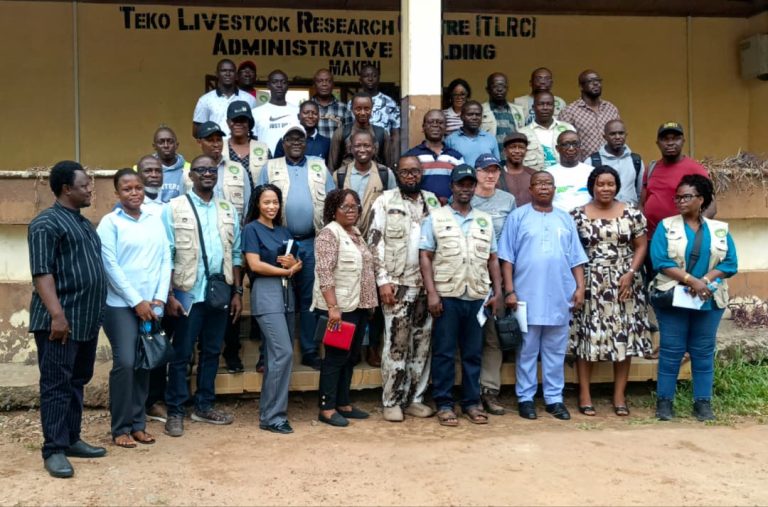
Representatives
from LLDP’s Bo Office participated in the exercise alongside the project’s
Social, Environmental and Climate Assessment Procedures (SECAP)
Specialist, Madam Cecelia Becker, who led environmental and social
safeguard assessments to ensure that all planned activities meet sustainability
standards and are implemented responsibly.
At
the heart of the initiative is the establishment of foundation seed
multiplication plots that will produce high-quality forage seeds and seedlings
for future distribution to farmers across the country. These planting materials
will support better livestock nutrition, improve animal productivity, and
contribute to stronger and more resilient livestock value chains.
Speaking
during the exercise, Dr. Dauda Sheku Yillah, Officer-in-Charge of the
Teko Livestock Research Centre, emphasized the importance of the intervention
in supporting livestock farmers and enhancing food security. He noted that
improving access to quality forage is essential for increasing livestock productivity,
reducing feed shortages, and creating new opportunities for rural households
that depend on livestock for their livelihoods.
Following
a comprehensive site assessment led by Madam Cecelia Becker, the proposed
location was approved for implementation, paving the way for land preparation
and the next phase of the programme.
The
initiative will focus on multiplying several improved forage species,
including: Brachiaria ruziziensis; Mucuna pruriens; Andropogon gayanus; Lablab
purpureus; Stylosanthes guianensis; Brachiaria mutica; and Chloris gayana.
These
forage species were carefully selected for their ability to improve feed
availability, restore degraded grazing lands, increase climate resilience, and
support sustainable livestock production systems. Their multiplication
represents an important investment in the long-term growth of Sierra Leone’s
livestock sector and the broader success of the Feed Salone agenda.
Beyond
seed production, the project will also strengthen farmers’ knowledge and skills
in fodder production, harvesting, storage, and conservation, helping livestock
producers maximize feed resources throughout the year. This capacity-building
component will be critical in ensuring that the benefits of the initiative
reach farming communities nationwide.
The
collaboration between LLDP and SLARI demonstrates the power of research,
innovation, and partnership in driving agricultural transformation. By
combining scientific expertise with practical field implementation, the
partnership will accelerate the development and dissemination of livestock
technologies, improve feed and fodder systems, and promote evidence-based,
climate-smart livestock practices.
As
the initiative moves into the foundation seed multiplication phase, it
represents more than just a research activity. It is a strategic investment in
the future of Sierra Leone’s agriculture sector and a direct contribution to
the Feed Salone vision of a food-secure, self-sufficient, and prosperous
nation.
Through
the combined efforts of MAFS, LLDP, SLARI, and the Teko Livestock Research
Centre, Sierra Leone is laying the foundation for healthier livestock, stronger
rural livelihoods, and a more resilient agricultural economy where farmers have
the resources, they need to feed the nation.
#FeedSalone
#LLDP #SLARI #FeedSierraLeone #LivestockDevelopment #ClimateSmartAgriculture
#ForageProduction #FoodSecurity #SustainableAgriculture #RuralLivelihoods