
SLARI/IITA/MAFS/ISRIC Develops National Soil Information Roadmap to Support Feed Salone Initiative
-
by
Slari Web Admin
- 1 Comment on SLARI/IITA/MAFS/ISRIC Develops National Soil Information Roadmap to Support Feed Salone Initiative

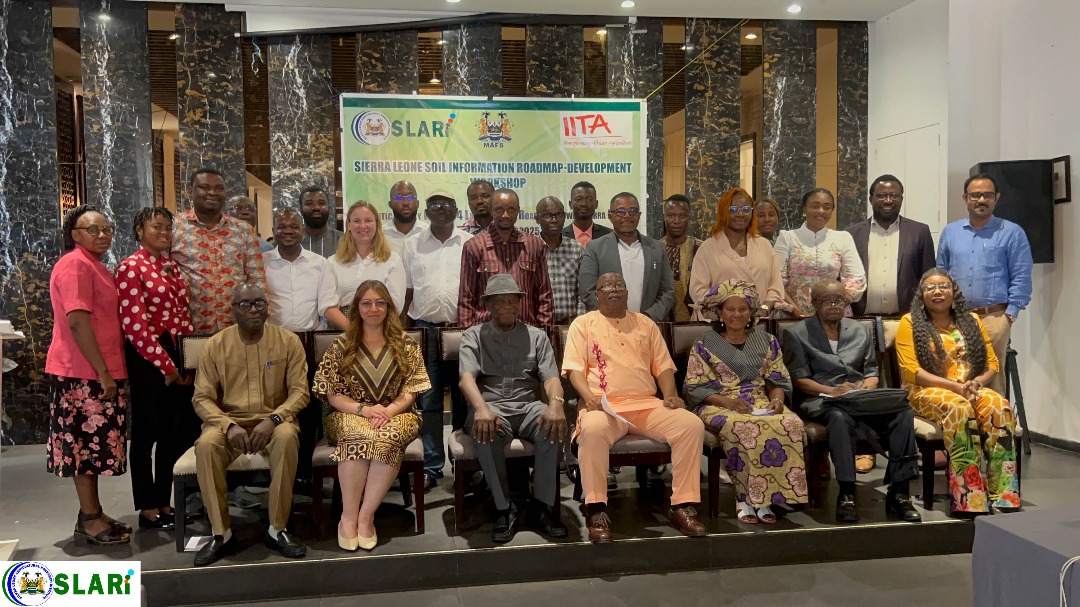
The Sierra Leone Soil Information Roadmap-Development Workshop, jointly organized by the International Institute of Tropical Agriculture (IITA), the Sierra Leone Agricultural Research Institute (SLARI), the Ministry of Agriculture and Food Security (MAFS), and the International Soil Reference and Information Centre (ISRIC), successfully concluded on October 15, 2025, at the Atlantic Hotel, 84 Lumley Beach Road, Freetown.
The three-day workshop, held from 13th to 15th October 2025, brought together leading soil scientists, agricultural researchers, policymakers, and international experts from ISRIC – World Soil Information, Netherlands. The objective was to develop a comprehensive national roadmap for the collection, management, and application of soil data to guide sustainable land use and enhance agricultural productivity across Sierra Leone.
Speaking during the opening ceremony, representatives from IITA, SLARI, and MAFS underscored the crucial role of accurate soil information in ensuring food security and in supporting the Government of Sierra Leone’s flagship Feed Salone Initiative, which seeks to transform the agricultural sector through science, innovation, and evidence-based planning.
Dr. Abdul Rahman Conteh, Ag. Director General of SLARI, highlighted that the roadmap will serve as a strategic tool for harmonizing soil information across research institutions, universities, and ministries.
“This roadmap will enable us to make informed decisions about crop suitability, soil fertility management, and land restoration efforts. Reliable soil data is the foundation for achieving the Feed Salone goals of self-sufficiency and sustainable food systems,” he emphasized.
The workshop featured technical sessions led by ISRIC soil experts from the Netherlands, who guided participants through modern soil information systems, mapping techniques, and digital soil data management tools. Through interactive discussions and group exercises, participants identified national priorities and strategies for developing a National Soil Information System (NaSIS), which will serve as a repository for soil data and inform future agricultural interventions.
Dr. Alfred O. Dixon, IITA’s country representative, commended the collaborative spirit shown by Sierra Leonean institutions and reaffirmed IITA’s commitment to strengthening national research capacities.
“This effort marks a major milestone in Sierra Leone’s journey toward evidence-based agricultural transformation. With robust soil data, policymakers and farmers alike can make smarter, climate-resilient decisions,” he stated.
The representative of the Ministry of Agriculture and Food Security noted that the roadmap will complement the government’s broader Feed Salone agenda by supporting site-specific fertilizer recommendations, promoting sustainable soil management, and ensuring that farmers have access to technologies that improve productivity while conserving natural resources.
At the end of the workshop, participants agreed on key next steps, including finalizing the roadmap document, establishing a national soil data coordination platform, and mobilizing resources for the operationalization of the Soil Information System.
The Sierra Leone National Soil Information Roadmap is expected to serve as a guiding framework for research, policy, and investment decisions, ensuring that every agricultural intervention under Feed Salone is based on solid scientific evidence about the land and soils that sustain it.
Comment (1)
slari
SLARI is on track. Keep up the good work.