Success Story: Transforming Value Chains through IITA Technical Backstopping to SLARI (FSRP – World Bank)
-
by
Slari Web Admin
- No Comments on Success Story: Transforming Value Chains through IITA Technical Backstopping to SLARI (FSRP – World Bank)
Before the commencement of the IITA technical backstopping to SLARI under the FSRP (World Bank-funded program), Sierra Leone’s soybean and cassava value chains faced significant challenges. Limited access to quality breeder seeds, weak adherence to phytosanitary standards (especially aflatoxin mitigation), low farmer productivity, and inadequate value addition constrained growth. Farmer training was fragmented, youth engagement in agribusiness was minimal, and standardized recipes or product development for soybean utilization were largely unavailable.
These gaps threatened national food security and the success of the Feed Salone Strategy. Farmers struggled with low yields and poor market access, while the absence of structured seed systems and limited technical capacity hindered scalability. Without urgent intervention, the opportunity to strengthen livelihoods and build resilient agricultural systems risked being lost.
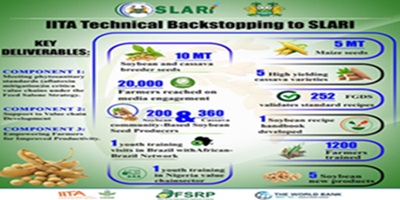
Through strategic technical backstopping, IITA supported SLARI across three key components: improving phytosanitary standards, strengthening value chains, and empowering farmers. Over three years, the project delivered 10 metric tons of soybean and cassava breeder seeds and 5 metric tons of maize seeds, ensuring access to improved planting materials. It introduced 5 high-yielding cassava varieties to boost productivity.
Capacity building was scaled significantly: 1,200 farmers were trained, alongside 200 soybean and 360 cassava community-based seed producers. To strengthen knowledge dissemination, 20,000 farmers were reached through media engagement. Youth inclusion was prioritized through training programs in Brazil and Nigeria, enhancing expertise in value chain development.
In nutrition and value addition, the project facilitated 252 Focus Group Discussions (FGDs) to validate standardized recipes, culminating in the development of 1 soybean recipe handbook and 5 new soybean products.
After three years, the transformation is evident. Farmers now have reliable access to improved seeds, leading to increased yields and resilience. The strengthened seed systems and trained 560 community-based producers ensure sustainability. Enhanced awareness and adoption of improved practices among 20,000 farmers have elevated production standards nationwide.
Value addition has expanded market opportunities, with new soybean products and standardized recipes improving nutrition and income generation. Youth participation has injected innovation into the sector, while adherence to phytosanitary standards has improved food safety.
Overall, the IITA–SLARI collaboration under FSRP has shifted the agricultural landscape from low productivity and limited coordination to a more structured, knowledge-driven, and market-oriented system—directly contributing to improved livelihoods and advancing the Feed Salone agenda.